
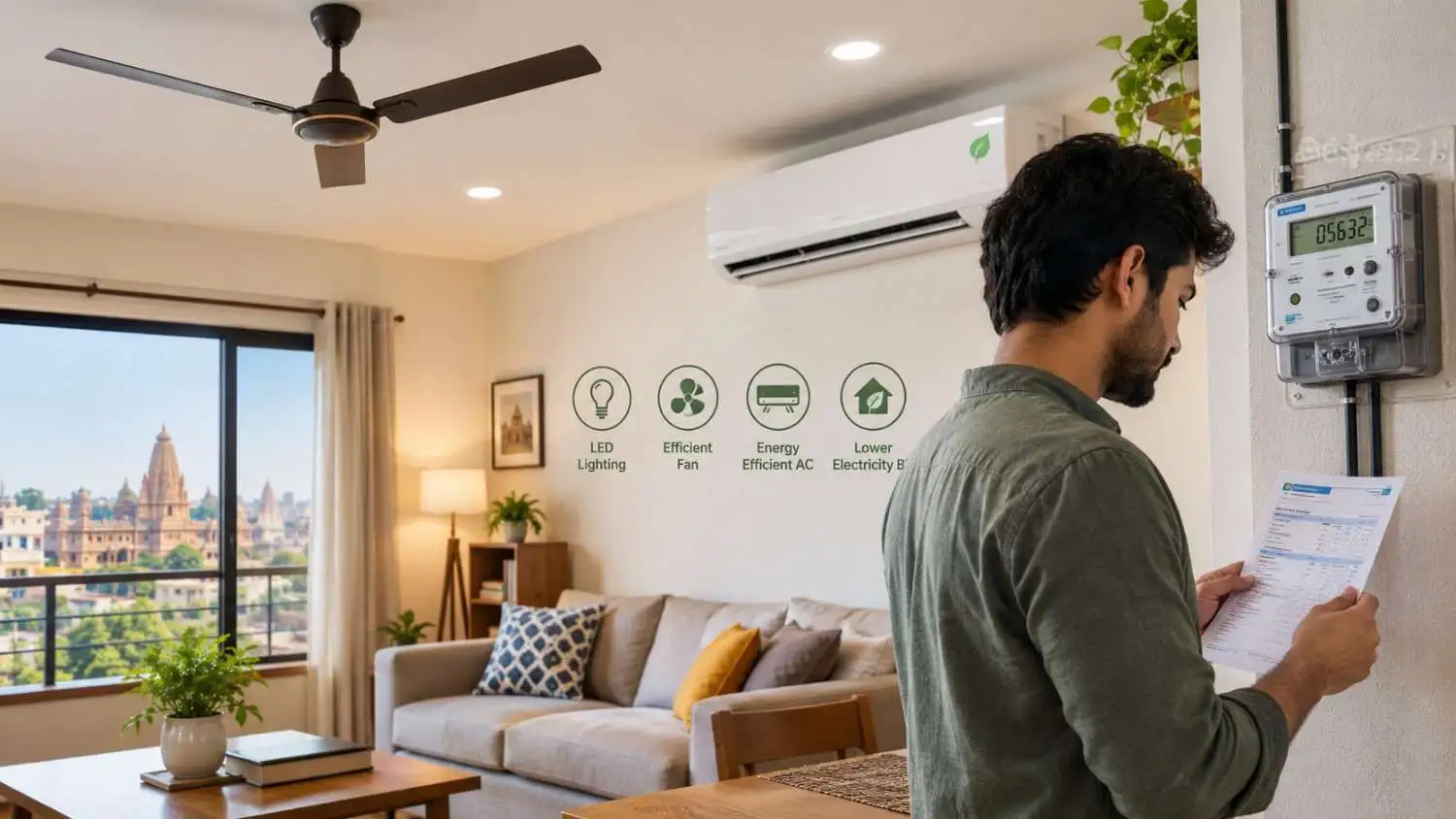
How to Reduce Electricity Bill in UP
A high electricity bill in Uttar Pradesh does not always mean you need to buy new appliances and discard the old ones out of fear that they consume more electricity. Sometimes, the problem is simply higher monthly consumption or a billing error.
If your electricity bill has increased suddenly, then check your previous bill, units consumed, tariff category, and fixed charges. Also audit how much you use air conditioners, geysers, water pumps, and other power-hungry appliances.
12 Practical Ways to Reduce Electricity Bill in UP
12 practical ways to save money by reducing electricity bills are
as follows:
1. Check Your Electricity Bill Before Changing Your Lifestyle
Before spending money on energy-efficient appliances, understand why your current bill is high. Open your latest UPPCL electricity bill and compare it with the previous billing cycle. Focus on these four details:
| Bill detail | What to check |
| Units consumed | Has your monthly consumption increased? |
| Sanctioned load | Are you paying for more connected load than you need? |
| Tariff category | Is your connection correctly classified as domestic? |
| Due date | Have late payment charges been added? |
For example, suppose your household normally consumes 130 units per month, but the latest bill shows 190 units. Instead of immediately blaming the electricity provider, consider whether you used an air conditioner more frequently, operated a water pump for longer, or added another appliance.
If consumption has increased without a clear reason, compare meter readings and check whether the bill contains an estimated reading or an unusual adjustment.
The first step toward a lower bill is identifying what caused the increase.
2. Understand Why Your Electricity Bill Increases in Summer
Electricity bills in Uttar Pradesh often rise during summer because cooling appliances consume more electricity. A household that uses 130 units during cooler months may reach 190 units or more when air conditioners are used regularly.
For general urban domestic consumers under LMV-1, the FY 2026–27 tariff schedule includes a fixed charge of ₹110 per kW per month and energy charges that vary by consumption slab. Rural domestic schedules have different charges. The actual payable amount may also depend on applicable adjustments, electricity duty, rebates, and other billing components.
3. Reduce Geyser and Water Heater Consumption
Geyser is very important nowadays, but use it carefully. One common mistake that you should avoid is not heating the water again and again. Just do it when you need hot water. For example, if your household needs hot water only in the morning, then don’t keep the geyser operating throughout the day.
4. Use Your Air Conditioner More Efficiently
You do not necessarily need to stop using it. A few adjustments can help reduce unnecessary consumption.
Set your AC temperature around 25°C
Using AC at 16°C or 17°C means you are consuming more units than usual. A setting around 25°C is a practical starting point for balancing comfort and energy use.
Keep doors and windows closed
Keep the door closed. Don’t let cool air escape. and use curtains to reduce direct sunlight.
Use the correct AC capacity.
An oversized or undersized AC may not operate efficiently for your room. Consider room size, insulation, sunlight, and occupancy before purchasing a new unit.
If you are buying an AC, compare its BEE star rating and annual energy consumption rather than choosing only by purchase price.
5. Replace Traditional Lights With BEE-Labelled LEDs
If your home still uses conventional tube lights or incandescent bulbs, replace them with efficient LED lighting. LEDs generally consume less electricity for the same level of brightness and have a longer operating life.
6. Identify Appliances That Consume More Electricity
Not every appliance contributes equally to your electricity bill.
The following equipment deserves closer attention:
| Appliance | Why consumption can be high | Practical action |
| Air conditioner | The compressor operates for extended periods. | Use a moderate temperature and maintain filters. |
| Electric water heater | Heating requires substantial power. | Heat water only when needed. |
| Water pump | Longer operating hours increase consumption. | Check leaks and avoid unnecessary pumping. |
| Room heater | High heating demand | Use only when required. |
| Agricultural equipment | Motor operation and usage hours | Maintain motors and use suitable equipment. |
| Refrigerator | Runs throughout the day | Maintain door seals and ventilation. |
A useful habit is to monitor appliances individually rather than assuming that every increase comes from the same source.
7. Reduce Your Sanctioned Load if You Do Not Need It
This is one of the most overlooked ways to reduce electricity bills in Uttar Pradesh. Your sanctioned load is the electrical load approved for your connection. Depending on your tariff, fixed charges are calculated using this load.
For example, under the general urban domestic fixed charge of ₹110 per kW per month:
| Sanctioned load | Monthly fixed charge |
| 1 kW | ₹110 |
| 2 kW | ₹220 |
| 3 kW | ₹330 |
| 5 kW | ₹550 |
These figures illustrate fixed charges only, not the complete electricity bill.
Imagine a household with a 5 kW connection that no longer uses heavy appliances. It may be paying ₹550 monthly in fixed charges alone, even before consuming electricity.
If your actual requirements are lower, check whether a sanctioned-load reduction is appropriate.
How to request a load reduction
Consumers can check the relevant online service through their DISCOM’s official portal or contact customer support for the applicable process.
Before applying, consider:
- Your AC capacity
- Water pump requirements
- Geyser and heater usage
- Appliances that may operate simultaneously
- Future household requirements
Do not reduce your load blindly. An unnecessarily low sanctioned load can create operational problems or require another modification later.
8. Check Whether Your Electricity Bill Contains an Error
Sometimes the problem is not consumption but incorrect billing information.
Review the following details:
Incorrect meter reading: Compare the current reading on your meter with the reading printed on the bill.
Wrong tariff category: Always check the correct category.
Incorrect consumer details: Verify your name, address, account number, and connection information.
Unexpected sanctioned-load increase: Check whether the recorded load matches your approved connection details.
Unusual additional charges: Look for arrears, adjustments, late fees, or other entries that you do not recognize.
If something appears incorrect, raise a complaint through your relevant DISCOM or UPPCL’s official consumer service. Consumers can contact 1912 for electricity-related complaints and assistance.
Do not ignore a billing discrepancy simply because the payment amount appears small.
9. Use Prepaid Smart Meter Features
If you have a prepaid smart meter, take advantage of its consumption monitoring features.
UPPCL’s smart meter services provide options for checking prepaid balances and managing recharges. Official consumer information also advertises a 2% discount associated with smart-meter arrangements.
Check the applicable rebate conditions and whether the discount applies to fixed charges or another specified billing component. Do not assume it reduces every part of your bill.
The more useful benefit for everyday savings is consumption visibility.
For example, if your normal daily usage suddenly increases, investigate whether an AC, water heater, pump, or another appliance is responsible.
Tracking usage can help you identify waste before it becomes a large monthly expense.
10. Pay Your Electricity Bill Before the Due Date
Late payment charges can increase the amount you owe.
Make a habit of checking the due date on every bill and paying through an authorized payment channel.
You should also check whether a prompt-payment discount is applicable under your consumer category and the current tariff conditions.
A discount is useful, but avoiding late fees is equally important.
If you have already received a bill with a late payment charge, review the payment history and due date before assuming the charge is incorrect.
11. Consider Rooftop Solar for Long-Term Savings
If you are fed up with high electricity bills and have a suitable rooftop, solar power may be worth considering. Unlike small lifestyle changes, rooftop solar requires one-time investment, but it can reduce the amount of electricity you purchase from the grid.
PM Surya Ghar Muft Bijli Yojana subsidy
Under the central residential rooftop solar subsidy structure, the standard subsidy is:
| Solar capacity | Central subsidy |
| 1 kW | ₹30,000 |
| 2 kW | ₹60,000 |
| 3 kW | ₹78,000 |
| Above 3 kW | Maximum ₹78,000 |
The subsidy is capped at 3 kW for individual residential systems under the standard structure.
Eligible households can apply through the official PM Surya Ghar National Portal and select an eligible vendor. Actual installation costs, system generation, roof conditions, and eligibility requirements must be checked before making a decision.
12. Adopt Simple Energy-Saving Habits at Home
Start with habits that fit your daily routine:
- Switch off appliances when they are not needed.
- Avoid unnecessary use of high-power equipment.
- Use natural daylight whenever possible.
- Run washing machines with suitable full loads.
- Keep refrigerators properly maintained.
- Don’t use water pumps longer
- Choose energy-efficient appliances when replacing old ones.
- Monitor monthly consumption rather than checking the bill only when it arrives.
Small improvements across multiple appliances can make a meaningful difference over time.
Know Your Consumption Before Paying More
Reducing electricity expenses starts with understanding where your money goes.
Check your latest bill, compare monthly units, review your sanctioned load, and identify appliances that contribute most to consumption. If you already know your monthly units, use our Uttar Pradesh Electricity Bill Calculator to estimate your bill and understand how consumption and applicable charges affect the total.
An informed household can make better decisions about electricity usage without sacrificing everyday comfort.
Frequently Asked Questions
Start by checking your monthly units, sanctioned load, and tariff category. Use ACs and geysers efficiently, replace inefficient lighting, monitor heavy appliances, and investigate billing errors. Rooftop solar may also help eligible households.
Yes, as you need to compromise, but a moderate temperature prevents using unnecessary units. Actual savings depend on room conditions, AC efficiency, outdoor temperature, and operating hours.
It can reduce fixed charges when your applicable tariff calculates them per kW.
Compare current and previous meter readings, units consumed, billing days, and additional charges. If anything is incorrect, call 1912.
It may be worthwhile for households with suitable rooftops and consistent electricity consumption. Consider the installation cost, eligible subsidy, system capacity, expected generation, and applicable grid-connection rules before investing.
A smart prepaid meter can help you monitor consumption and identify unusual usage. However, the meter itself does not automatically reduce electricity consumption.
Your bill may include fixed charges, previous arrears, adjustments, electricity duty, or other applicable components. Compare every single detail.